Every year, around mid-September, Japan’s rice paddies, cemeteries, and roadsides turn a vivid shade of red with these distinctive flowers. They’re called Higanbana (彼岸花), known in English as the red spider lily (Lycoris radiata). Few flowers in Japanese culture carry as many layers of meaning — botanical, religious, astronomical, and even in pop culture — as this one.
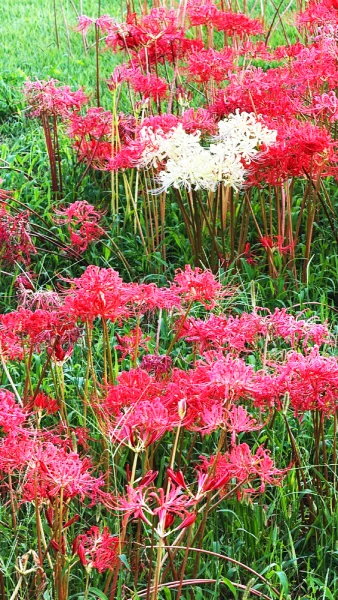
The first thing that stands out about this flower is its inverted life cycle: it sprouts directly from the bulb, with no leaves, sending up a stem 30 to 50 cm tall crowned by a flower with thin, backward-curving petals, almost like fireworks. Only after the flower withers do the leaves appear. This sequence — never seeing the flower and the leaf together — gave rise to the popular saying hamizu hanamizu (葉見ず花見ず), “sees no leaf, sees no flower,” which reinforces its aura of mystery.
The bulb also contains toxic alkaloids (including lycorine). For centuries, farmers deliberately planted it along the edges of rice paddies and in cemeteries: its toxicity kept away rats, moles, and other pests that would otherwise damage crops or disturb graves. This practical use is partly why the flower became almost exclusively associated with cemeteries, and why in Japan it’s still considered poor taste — even today — to include it in a bouquet or bring it into a home.
This association with death earned it, over time, some rather grim nicknames: shibito-bana (“flower of the dead”), yūrei-bana (“ghost flower”), or jigoku-bana (“hell flower”). Counting regional variants, the plant is said to carry more than a thousand folk names across Japan.
The name “Higanbana” is made up of higan (彼岸) and hana (花, “flower”). Higan is a Buddhist term meaning, literally, “the other shore”: the shore opposite the river of suffering (samsara) — that is, the state of enlightenment or the afterlife reached after leaving behind the world of earthly passions (shigan, “this shore”). It isn’t a concept exclusive to a single school, but it takes on a very specific meaning within the currents of Pure Land Buddhism — Jōdo-shū, founded by Hōnen, and Jōdo Shinshū, founded by Shinran — for which there exists a Western Pure Land (Saihō Gokuraku Jōdo), the paradise of Amida Buddha, located literally to the west. Other Japanese schools, such as Zen or Nichiren Buddhism, understand enlightenment differently and don’t place a geographic paradise in that direction, so this “western” reading of the afterlife belongs mainly to the Pure Land tradition.
This is where the autumn equinox comes in. During the week surrounding it — three days before and three days after — day and night last almost exactly the same length, and the sun sets due west. For the Pure Land tradition, that alignment symbolizes that, on those days, the boundary between “this shore” and “the other shore” grows thinner and easier to cross. This period is called “Ohigan” (お彼岸), and it’s when Japanese families visit their ancestors’ graves (ohakamairi), clean the headstones, and offer flowers and incense. It’s no coincidence that the Higanbana blooms exactly during these days: its flowering, its color, and its historic ties to cemeteries turned this flower into the visual emblem of the “Ohigan” season.
Interestingly, this same flower also has a far brighter name: manjushage (曼珠沙華), a term of Sanskrit origin that appears in the Lotus Sutra, one of the central texts of Japanese Buddhism. According to the sutra, when Buddha delivered his teaching, celestial flowers fell from the sky as an auspicious sign; one of them was the manjushage, whose name means something like “flower of heaven” or “red flower that blooms before the leaf.” So a single flower holds two opposing readings: the earthly, funerary one of “Higanbana,” and the celestial, auspicious one of “manjushage.”
There’s also a folk legend linking the flower to the Sanzu River, which in Japanese Buddhist mythology separates the world of the living from that of the dead, with the Higanbana said to be one of its emblematic flowers, blooming along its banks as a symbol of the cycle of death and rebirth.
Thanks to its striking appearance and symbolic weight, the Higanbana became a common visual device in Japanese fiction for representing death, loss, the afterlife, or reunions that can never happen. It appears in well-known titles such as Jigoku Shoujo (Hell Girl), Inuyasha, and Kimetsu no Yaiba (Demon Slayer), where it typically functions as a symbol of death and rebirth. Writers and artists often use it to foreshadow a farewell, mark the threshold into a spiritual realm, or signal a painful, unrecoverable memory, always drawing on the flower’s real weight within Japanese culture.
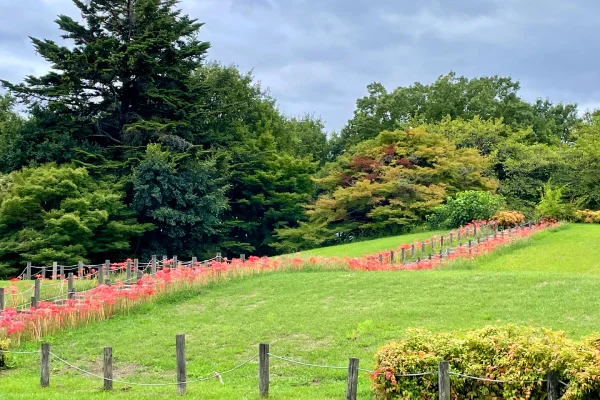
With its enormous historical weight and rural character, Nara offers some of the most photographed settings in all of Japan for the September bloom:
Less than an hour from Nara City, Asuka packs rice terraces, kofun (japanese ancient burial mounds), and temples into just a few square kilometers, making it the prefecture’s most complete destination for experiencing the Ohigan season alongside its emblematic flower.
The Higanbana brings together, in a single plant, Japanese folklore, Buddhist doctrine, and even astronomy!
Seeing it bloom in Nara during the week of the autumn equinox is, in a sense, witnessing live one of the oldest metaphors in Japanese Buddhism about the passage between worlds.

