Picture this. The sun drops behind the hills. The tour buses leave. Nara Park goes quiet. Then, one by one, thousands of small candle flames light up the grass, the ponds, and the old stone paths where wild deer rest for the night.
This is Nara Tokae, and for ten nights every August, it turns one of Japan’s oldest cities into something you won’t forget.
Nara Tokae started in 1999. In 2026 it celebrates its 28th year. The name comes from “toka,” the small flower shaped bit of wax that forms at the tip of a burning candle wick. In old Japanese belief, seeing one form is a sign of good luck.
Every summer, volunteers place thousands of candles across Nara Park and light them by hand. The result is simple and quiet. No fireworks. No loud music. Just soft light spread across a landscape that has stood for over 1,300 years.
In 2026, Nara Tokae runs from August 5 through August 14. Organizers light the candles each night from 7pm to 9.30pm.
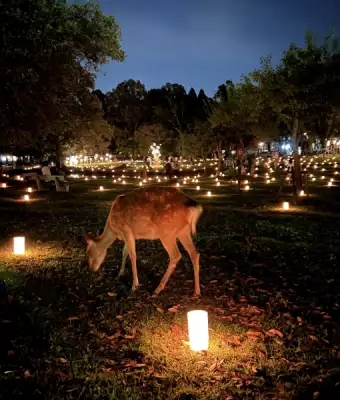
The festival spreads across several spots in and around Nara Park, and each one has its own character.
1. Kasugano Field holds the largest field of candles, set against Todaiji Temple and Mount Wakakusa.
2. Ukigumo Park lays out its candles like a river of stars on the ground.
3. Asajigahara mixes candlelight with bamboo lantern sculptures tucked among the trees.
4. Ukimido Pavilion seems to float on Sagi Pond, ringed by candlelight and small boats.
5. Sarusawa Pond and its 52 stone steps carry a local legend about a sorrowful court lady, and the candlelight on the water adds to the mood.
6. Kofukuji Temple lights its north approach, framing the five story pagoda in a warm glow.
7. The area in front of Nara National Museum joins in too.
8. Iraka Hall offers food and drinks alongside its own candlelit garden.
Two spots only join for part of the run. Todaiji Temple lights up on August 13 and 14 only, and Kasuga Taisha Shrine joins just on August 14, when its own lanterns add to the display. If your trip lines up with those two nights, you get the fullest version of the festival.
Nara Tokae goes ahead in light rain, so don’t let a drizzle stop your plans. Heavy rain can put out the candles, though, and that may cut the event short.
The park has no trash bins during the festival, since bins attract deer that end up eating plastic. Bring your trash home with you. Skip the tripod too, since crowds make them a hazard. And please don’t feed the deer anything besides the official deer crackers sold in the park. Public transport works far better than driving, since parking is limited and illegal parking causes serious traffic problems for the whole are.
Reading about candlelight is one thing. Walking through it is another.
Our Nara Night Tour runs through July, August, and September, which means it lines up perfectly with Tokae season. We pick you up at 6pm at Kintetsu Namba Station in Osaka, or you can join us at 7pm at Kintetsu Nara Station if you’re already in town. Your guide speaks English, Japanese, and Spanish, and the tour costs 48 US dollars per person.
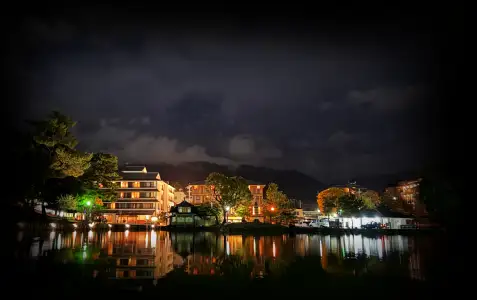
The route takes you straight through several of the festival’s own venues. You’ll walk through Nara Deer Park among the sleeping and wandering deer, pass by Nara National Museum, and stop at Todaiji Temple to see its towering South Gate, its 1,200 year old bell, and the view from Nigatsudo Hall. From there you’ll head to Ukimido Pavilion, the first torii gate of Kasuga Taisha, Kofukuji Temple’s South Octagonal Hall, and finally Sarusawa Pond, home to that same court lady legend.
Book your tour for August 13 or 14 and you’ll catch Todaiji and Kasuga Taisha at their candlelit best, on the only two nights they join the festival. Any night from August 5 to 14 still puts you right in the middle of Nara’s other candlelit venues, walking the same paths as the festival itself.
The tour wraps up at 10:00pm at Nara Station, so you can still catch a late train home.
Nara by day is beautiful. Nara by candlelight is something else entirely. Book your spot on our Nara Night Tour and see it for yourself.

