A horn sounds across a quiet field at Kasuga Taisha Shrine. Within seconds, dozens of wild deer come running from the trees. This happens almost every Sunday morning this summer in Nara, and most visitors never see it.
We built our tour schedule around this event. Every Sunday during shika yose season, we move our small group tour start time from 9 am to 8 am, specifically so you can be there while the horn is still sounding. As far as we know, we are one of the only tour operators in Nara that changes its schedule for this reason.
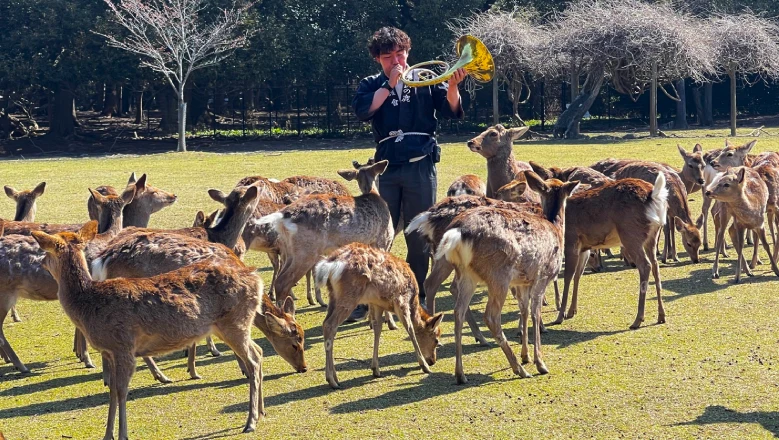
Locals call it shika yose, or deer calling. A handler plays a natural horn, the same kind used in old hunting traditions, and the sacred deer of Kasuga Taisha respond on cue. They gather at Tobihino, the open meadow inside the shrine grounds, drawn by a sound they have learned to associate with feeding.
The tradition goes back generations. Farmers once used horn calls to gather deer away from their crops. Over time, the practice became a beloved ritual that now draws travelers from around the world. Watching a herd of wild deer answer a horn call, together, on command, feels like something out of an old folk tale. It is real, and it happens right in front of you.
The Nara City Tourism Association runs this event every Sunday from July 19 through September 27, 2026, with one exception on September 6. Each session starts at 9 am and lasts about 15 minutes. The location is Tobihino, inside the grounds of Kasuga Taisha shrine. Admission is free, and organizers hold the event rain or shine, only canceling in severe weather.
Fifteen minutes sounds brief, and it is. That is exactly what makes this event so easy to miss.
Nara draws huge numbers of day trippers from Osaka and Kyoto, and almost all of them arrive after 9 or 10 in the morning. By the time a typical group tour reaches Kasuga Taisha, the deer calling has already ended. The horn only sounds once, for a quarter of an hour, on a Sunday morning. If your tour starts at the standard time, you simply are not there for it.
That one hour change, from 9 am to 8 am, puts you at Kasuga Taisha while the horn is still sounding and the deer are still gathering. You get more than a quick photo stop. Your guide walks you through the meaning behind the ritual, why the deer respond to the horn, and how this tradition connects to the sacred status deer have held in Nara for over a thousand years.
After the deer calling, your guide leads you through Nara Park, where more than a thousand deer roam freely and will approach you for a closer look. From there you walk to Todaiji Temple, home to Japan’s largest bronze Buddha and a UNESCO World Heritage Site, including the Great South Gate and the Nigatsudo Hall with its wide view over the city. The tour finishes at Kasuga Taisha itself, famous for its path lined with thousands of stone lanterns.
The whole experience runs about 4 hours, in a small group, with a local guide who lives in Nara and knows the city beyond the standard postcard spots.
This event only runs on Sundays, only during summer, and only for 15 minutes each time. Once September 27 passes, you wait until the next scheduled season to see it again. Space in our small group tour is limited, and Sundays during shikayose season fill up faster than other days.
If you want to see Nara’s deer answer a horn call at Kasuga Taisha, book the Sunday morning tour now and we will have you there at 8 am, ready for one of the most unusual sights in Japan.

