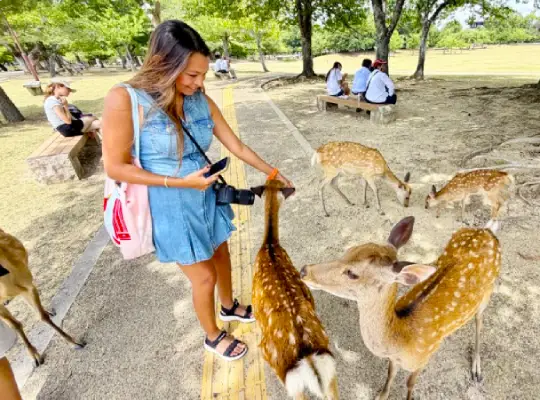
Nara has never had this many deer. On July 16, 2026, the Nara Deer Preservation Foundation (奈良の鹿愛護会) released its yearly headcount: 1,687 deer living in and around Nara Park. That’s 222 more than last year, the fifth increase in a row, and the highest number since the count began in 1953.
More deer means more bowing and more cracker-chasing. It also means more ways for a visit to go wrong. This autumn, Nara City Hospital has treated more people for deer-related injuries than in any year on record.
Here’s what the new count shows, and why we think the safest way to see these deer is with someone who knows them.
About 40 foundation staff and volunteers counted the deer by sight on July 15 and 16. Here’s what they found:
Total deer: 1,687
Adult males (bucks): 411
Adult females (does): 990
Fawns: 286
The shape of the increase matters as much as the total. The number of adult males jumped by almost a third in a single year. Males are the deer with antlers, and from September to November they’re in rut, the mating season, when they get territorial and short-tempered. More bucks in the park during autumn means more visitors standing near a deer that is in no mood to be crowded.
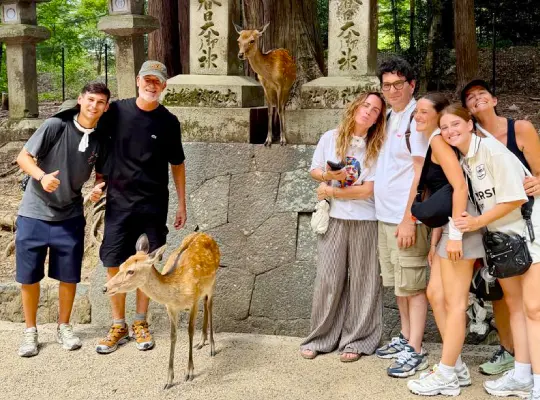
The foundation points to food. Visitors are feeding deer vegetables, leftovers and snacks other than the official shika senbei (deer crackers). Better-fed does now give birth every year, so the herd grows faster.
Nara’s deer are meant to graze mostly on the park’s grass. Deer crackers, made from rice bran and wheat flour, are a treat on top of that. Human food is a different story: it upsets their diet, and plastic bags and wrappers dropped in the park can kill them.
A crowded park has other side effects too. Deer are wandering out of the park and eating residents’ vegetable gardens, and some have been spotted in neighborhoods kilometers away.
In the year to the end of June 2026, 198 deer died. Traffic accidents were the leading cause, with 47 deer hit by cars, and 72 of the deer that died were fawns. Young deer following their mothers often dart into the road without warning.
As of November 5, 2026, 51 people had been taken by ambulance to Nara City Hospital after being hurt by deer. That’s the highest yearly total on record, up from 46 in 2025, 45 in 2024 and just 7 in 2021. More than 70% of this year’s patients were visitors from overseas.
Part of that is simply crowds. Foreign visitors to Nara went from about 46,000 during the pandemic to a record of more than 3.5 million in 2025, and many rarely get close to animals at home, so it’s easy to misjudge how near is too near. The injuries can be serious. In September, a deer was filmed charging a woman who had walked up to it, knocking her down and headbutting her again and again. Dr. Ryusuke Kawaguchi of Nara City Hospital says a buck’s antlers are so sharp it’s as if the deer has blades on its head. It only has to swing its head to hurt someone.
Visitors interviewed by ABC TV in the park described deer biting at their bags and nipping them while they held crackers. The deer quickly work out who has just bought a bundle, follow that person, and come up from behind to ask for more, sometimes with their teeth. A worker at a nearby shop told reporters that seeing a deer get angry after a tourist touches it happens all the time.
Yasuhiro Nakanishi, vice chairman of the Nara Deer Preservation Foundation, has said that many visitors from abroad assume they can walk right up to the deer and handle them. They can’t. In autumn especially, bucks get worked up and may attack people who come too close. The foundation started cutting the bucks’ antlers earlier than usual this year to reduce the risk, and in late September one deer even strolled through the automatic doors of the Nara Prefectural Government building.
Nara Mayor Gen Nakagawa was blunt when asked about the record on November 11. In his view, the deer in Nara Park live so close to people that visitors are forgetting they’re wild animals, and the message that deer can be aggressive and frightening has been getting lost. The prefecture has also launched a crowdfunding campaign, running until December 4, 2026, with a ¥30 million goal to improve the park so people and deer can share it more safely.
That’s easy to forget when a deer bows to you outside a souvenir shop. But they’re wild sika deer, protected as a National Natural Monument, and they act on instinct.
Most injuries happen in a handful of familiar situations:
The season you visit changes the risks too:
During the autumn rut, the Nara Deer Preservation Foundation warns against four things in particular:
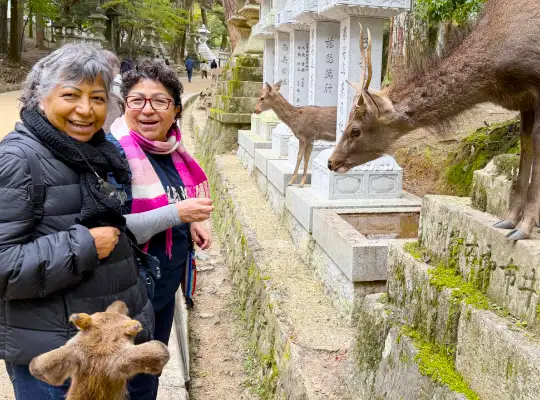
Our guides spend most of their working days in Nara Park. They see the same deer in the same spots, season after season, and they notice things a first-time visitor won’t.
On a Tours 2 Nara tour, your guide will:
• Read the warning signs for you. Ears pinned back, a lowered head, a stamped front hoof, a sharp snort or whistle. These usually come before a charge or a kick, and your guide will move you away before it happens.
• Show you how to feed deer properly. Buy only official shika senbei, keep the stack out of sight, hand out one piece at a time, and show your empty palms when you’re done so the deer lose interest.
• Watch your back. Deer remember who just bought crackers and follow them, then nip at bags, sleeves and legs from behind. Your guide keeps an eye on the deer behind you while you’re busy taking photos.
• Choose the right spots and times. Some areas get packed with deer and tour groups by mid-morning. We know quieter corners where you can enjoy the deer without being mobbed.
• Look after children and older travelers. We keep little ones close, help them feed deer safely, and steer families away from bucks during the rut.
• Handle the city around you. Busy road crossings near the park, big crowds at Todaiji, summer heat, getting lost between temples. Your guide takes care of the logistics so you can enjoy the day.
• Help if something does go wrong. If anyone in your group gets hurt or feels unwell, your guide knows where to go, who to call, and can speak Japanese for you at a clinic or hospital.
Most people come for the deer, but the deer are here because of the shrines and temples. Nara was Japan’s capital from 710 to 784, and the temples and shrines from that era are listed together as a UNESCO World Heritage Site, the Historic Monuments of Ancient Nara.
According to legend, the god Takemikazuchi rode into Nara on a white deer when Kasuga Taisha was founded, and the deer have been treated as sacred messengers of the gods ever since. That belief is why a modern city still lets 1,687 wild deer wander its streets.
A guide fills in what the signs leave out. Why Todaiji’s Great Buddha Hall, still one of the largest wooden buildings in the world, is about a third narrower than the one it replaced. Why Kasuga Taisha has some 3,000 lanterns, and which two times a year they’re all lit. Which old merchant houses in Naramachi are worth stepping inside.
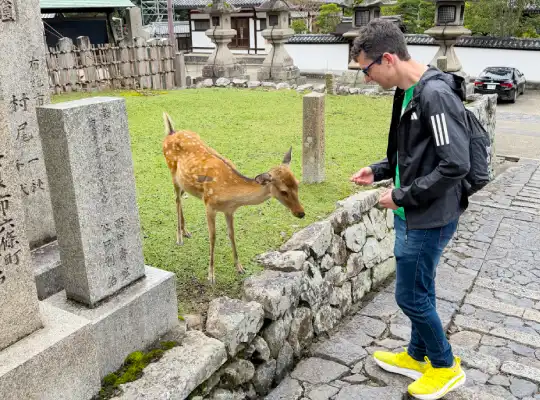
Nara isn’t one stop on a long Kansai itinerary for us. It’s all we do. Our guides live here and are in the park most days of the year, so they know which paths stay quiet on a busy Saturday, and how to keep a group safe while still getting you close enough for the photo you came for.
With 1,687 deer in the park and more injuries this year than ever before, a guide who can read the animals is the simplest way to enjoy Nara’s deer and skip the hospital visit.
Ready to meet Nara’s deer the right way? Browse our private and small-group tours and book your Nara guide at www.tours2nara.com.
The Nara Deer Preservation Foundation counted 1,687 deer on July 16, 2026: 411 males, 990 females and 286 fawns. It’s the highest number since the survey began in 1953.
They’re usually calm, but they are wild animals. They can bite, kick, headbutt and, in autumn, injure people with their antlers. In 2026, a record 51 people had been taken to Nara City Hospital by ambulance for deer-related injuries by early November.
You can see them all year. Winter and early spring are calmest. In fawning season (May to July) and the autumn rut (September to November), keep more distance, or go with a guide who can read the deer’s behavior.
Yes, but only with the official deer crackers (shika senbei) sold around the park. Never feed them human food, and always take your trash with you.
You don’t need one to enter the park. But with more deer and more injuries than ever, a local guide keeps you out of the situations that cause most injuries, and tells you the history behind what you’re seeing.

