YOSHINO MOUNTAIN, NARA PREFECTURE
— Toyotomi Hideyoshi, at his cherry blossom viewing party on Yoshino
Mountain, 159.
YOSHINO MOUNTAIN, NARA PREFECTURE
— Toyotomi Hideyoshi, at his cherry blossom viewing party on Yoshino
Mountain, 159.
Live Update — March 2026: Early-blooming trees near Shimo-Senbon are already
showing color — potentially a few days ahead of the official forecast. The 2026
season may be moving faster than expected.
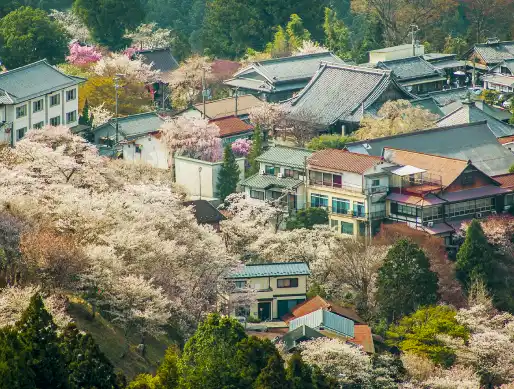
Every spring and autumn, Japan puts on a show. Yoshino Mountain is
something else entirely — 30,000 cherry trees blanketing a UNESCO World
Heritage sacred mountain, drawing visitors for over a thousand years. This
isn't a park or a riverside promenade. The trees were planted over centuries
as offerings to a mountain deity by followers of En no Gyoja, the founder of
Shugendo mountain asceticism. In a literal sense, these are sacred trees.
About 200 varieties grow here, dominated by the white-petaled Shiro
Yamazakura (wild mountain cherry). Unlike the Somei Yoshino lining city
streets across Japan, these mountain cherries bloom with leaves and flowers
emerging together — giving the whole mountain a softer, more painterly
quality. Less cotton-candy, more watercolor.
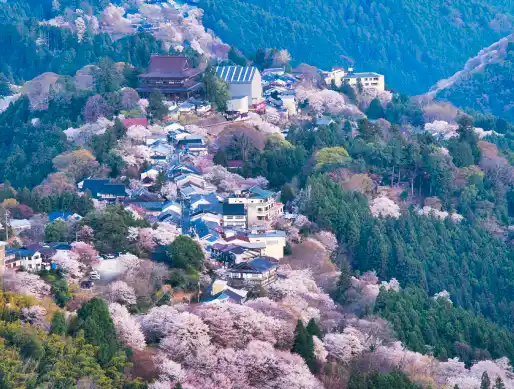
The bloom works its way up the mountain in stages, lower zones first, the
inner mountain last — giving the whole season a surprisingly long window.
And in November, those same hillsides transform into a canvas of crimson
and gold
Tsufuro Lake
Opens: March 26 / Full Bloom: April 1
Shimo-Senbon (Lower Slopes) WE VISIT
Opens: March 27 / Full Bloom: April 2
Naka-Senbon (Middle Section) WE VISIT
Opens: March 28 / Full Bloom: April 3
Kami-Senbon (Upper Section)
Opens: March 31 / Full Bloom: April 6
Oku-Senbon (Inner Section)
Opens: April 5 / Full Bloom: April 11
The sweet spot for the two zones on our itinerary — Shimo-Senbon and
Naka-Senbon — is roughly April 2nd through April 5th, when both should be
at or near full bloom simultaneously. With early reports suggesting the
season may be edging forward, the time to book is now.
Yoshinoya, the iconic Japanese beef bowl chain with locations around the
world , is named after Yoshino Mountain's cherry blossoms. The founder
was so moved by the beauty of the sakura here that he named his restaurant
after the place.
Getting Yoshino's timing right is genuinely hard, even for locals. When one
zone is in full bloom, another has already faded. Knowing the forecast and
having a plan in place is the difference between catching the show and
arriving a week too late.
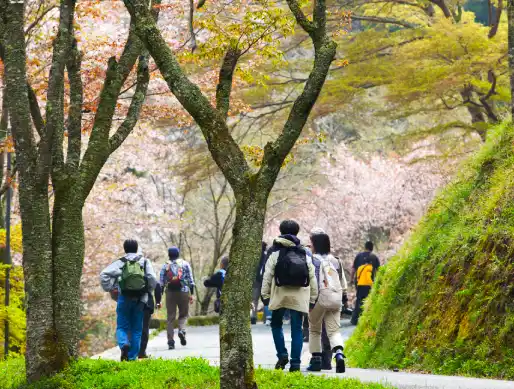
Walk among 30,000 sakura trees on Japan's most celebrated sacred
mountain.
✓ Shimo-Senbon & Naka-Senbon Cherry blossom zones
✓ Kimpusenji Temple (2nd largest wooden structure in Japan)
✓ "Hitome Senbon" panoramic viewpoint at Yoshimizu Shrine
✓ Traditional Japanese lunch
✓ English, Japanese & Spanish-speaking guide
✓ Duration: 8 hours
✓ Departs from Osaka
USD 148 per person
The same sacred mountain, ablaze in crimson and gold. With a Blue
Symphony ride and an authentic kuzu sweet-making experience.
✓ Yoshino autumn foliage trail
✓ Kimpusenji Temple — rare autumn opening of ancient statues
✓ Yoshimizu Shrine with fall foliage views
✓ Live kuzu sweet-making demo by local artisan + tasting
✓ Traditional Japanese lunch
✓ English, Japanese & Spanish-speaking guide
✓ ~8 hours
✓ Departs Osaka
USD 138 per person
Discover the highlights of our Autumn tour in Nara in the video below:
Car access is officially restricted during spring viewing season (March 20 – May
10). The Kintetsu Yoshino Line is the best way in.
Spring night illuminations run March 20 – April 19, 6–10 pm, at the Shimo-Senbon
and Kami-Senbon zones. If your timing aligns, the lit-up lower slopes at dusk are
unforgettable.
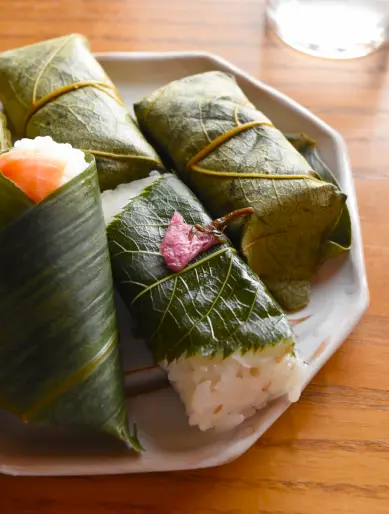
Try kakinoha-zushi (fish and rice wrapped in persimmon leaf) and Yoshino kuzu
sweets, sold at shops along the main path from the station. Our autumn tour
includes a live kuzu making demonstration.